Leo Fried
New Orleans 165 – 150 League City
Quadball Under Extreme Scrutiny Today is an attempt to deeply and more thoroughly analyze player and team performance in a quadball game or series. For each QUEST, I go play-by-play, analyzing and grading what and how each player did on each play, and then I compile those into grades for the game or series as a whole.
Standard disclaimer:
QUEST is admittedly a somewhat subjective process: I am assigning play-by-play grades based on my read as to who was responsible for each play going right and wrong. It is also very much a work in progress and I am very open to and would love your feedback — basically any medium is good. Individual players’ grades are just based on the particular games charted and are not an indication of players’ general ability or talent level. This is not meant to put down players who didn’t play as well. The purpose of this endeavor is to learn about and better understand our sport and these games.
In order to be able to continue to write these every week (hopefully), I am cutting down to a single game per week: in this case League City @ New Orleans Game 3. The full play-by-play chart is here, where I give individual player grades for each play of the series. Feel free to skip this entirely or just read a bit and then move on. Now, for the analysis.
Corporate needs you to find the difference between these two gifs.


They’re the same gif.
This game was played largely in transition, with both teams scoring more goals on the fastbreak than their respective halfcourts — a first in QUEST history. For League City, this meant it was time for Hayden Boyes to go to work.

Boyes had a nose for getting to loose balls and running with them: he was a large part of the Legends converting on eight of their ten fastbreak attempts. Here, Boyes turns getting pressed into a scoring opportunity, with an assist from Swathi Mannem (this was charted as a transition attempt.)

Boyes was the highest-grading player from game three, finishing at +20. There are piles of clips that are almost identical to the two above: with dodgeballs on the ground, Boyes was the player you wanted driving the rock and either shooting or finding a teammate open by the hoops.
Can you give that to me in chart form?
Chart.
| Player | Pluses | Minuses | Grade |
|---|---|---|---|
| Acosta | +8 | -3 | +5 |
| Boyes | +29 | -9 | +20 |
| Butler | +3 | -0 | +3 |
| Contreras | +1 | -2 | -1 |
| Dorsey | +17 | -15 | +2 |
| Evans | +0 | -0 | +0 |
| Hughes | +5 | -14 | -9 |
| Jeanlewis | +1 | -0 | +1 |
| Mandel | +1 | -0 | +1 |
| Mannem | +6 | -3 | +3 |
| Nellums | +2 | -0 | +2 |
| Price | +2 | -7 | -5 |
| Stewart | +4 | -3 | +1 |
| Wilkinson | +8 | -4 | +4 |
| Total | +87 | -60 | +27 |
Nice new fancy columns.
Oh yeah, charts just got an upgrade! I do think the difference between high usage/playtime players who accumulate lots of scores, positive and negative, and players who just don’t really accumulate grades in either direction, is interesting.
Boyes is the only Legend chaser (and, in fact, the only chaser in the game) whose score is greater than one goal in magnitude, accounting for +20 of the +27 produced by the unit in total.
In the halfcourt, League City’s success varied depending on what looks the Curse defense was throwing at them.
| Curse Defense | Goals | Stops |
|---|---|---|
| Transition | 8 | 2 |
| 2-2 | 7 | 9 |
| 1-3 | 0 | 5 |
Hmmm…
Midway through the game, New Orleans unveiled the hoop zone, proceeded to get five pretty convincing stops, and then shelved it for the rest of the game.
I feel like they should have played more 1-3.
I feel similarly.
The League City beaters looked to attack the hoop zone by throwing some surprisingly long-range beats at a hoop defender, but their chasers never put pressure on in sync, and so all that did was give the Curse beaters a chance to blow up the play: New Orleans got out in transition after four of the five possessions that they set up in the 1-3.
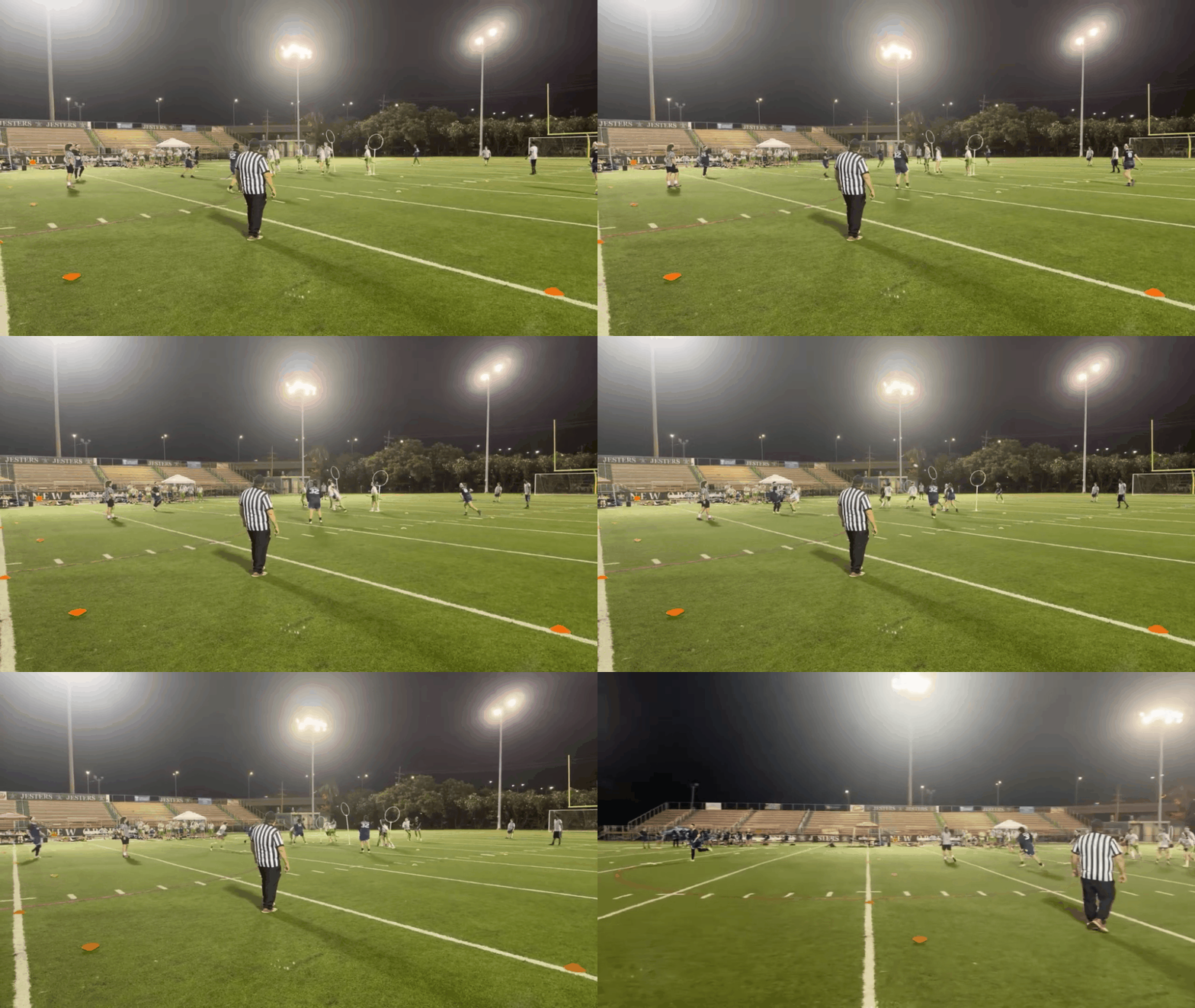
I wonder what this game would have looked like if New Orleans had stuck with the defense that went 5/5 on stops and 4/5 on setting up transition chances. I guess we’ll never know.
We wouldn’t have gotten that ending though!
Don’t even get me started. 29:55 into game three, New Orleans scores to tie the game at one-away, one-away. Over the next six minutes of game time and eleven minutes of real time, neither team could find the hoop, combining for a game-longest nine straight scoreless possessions including five unforced turnovers, until PJ Mitchell finally sent us home.

Speaking of, how was the New Orleans offense?
Chart.
| Player | Pluses | Minuses | Grade |
|---|---|---|---|
| Cascio | +8 | -3 | +5 |
| De La Rosa | +11 | -11 | +0 |
| Housey | +0 | -0 | +0 |
| Lewis | +19 | -15 | +4 |
| McCarroll | +0 | -0 | +0 |
| Mertens | +18 | -16 | +2 |
| Mitchell | +11 | -8 | +3 |
| Mueller | +1 | -2 | -1 |
| Provenazo | +0 | -0 | +0 |
| Running | +2 | -3 | -1 |
| Savino | +0 | -0 | +0 |
| Spicer | +9 | -7 | +2 |
| Thompson | +3 | -7 | -4 |
| Tramel | +6 | -9 | -3 |
| Total | +92 | -81 | +7 |
It was… fine? A lot of players who accumulated a lot of pluses and also a lot of minuses. In general, the Curse offense looked a bit shaky: unlike League City, they only scored on about half of their transition looks, and like the Legends, they scored on a third of their halfcourt ones. (Recall that League City outscored them in quadball points.)
Further, New Orleans seemed to lack an offensive gameplan — many halfcourts consisted of just chasers passing the quadball around the four corners of a box until beater play was decisive one way or another, and then trying to score from there. To their credit, on two different possessions they turned a League City press into a goal.

On one hand, this is a great job from Veronica Spicer, Marcellus Lewis, and Ebli De La Rosa to be creative and convert even while under duress. On the other hand, League City chasers, please for the love of all that is good step off the hoops and go mark somebody!
Pressing is sort of like cleaning your room. In the beginning, your room is messy, but livable (your opponent has the quadball, but you have the only beaters on broom). But then you start taking things off shelves and out of piles, and all of sudden you can barely walk around your room without stepping on something (your beaters take themselves out of position to force a tough pass from the offense). Finally, you put everything away where it belongs, and now your room is clean (your chasers mark the off-ball offensive chasers and pick off the pass).
If the defensive chasers don’t mark up, then you’ve stopped working after dumping everything on the floor, and now your room is a mess and you’ve been scored on!
That was an insane metaphor.
Thank you.
New Orleans did have a few nice possessions in the halfcourt, often based on this particular action from Joshua Mansfield.

The chasing game could be a bit smoother here, but they do convert. Mansfield ran this play — basically driving past the free beater, wrapping around hoops, and throwing at the beater with a dodgeball — a few different times during the game to great effect. Somewhat interestingly, this is a play you can only really run starting on the right sideline (for right-handed beaters): the mechanics just don’t work the other way.
Mansfield was particularly effective when New Orleans had the quadball and was looking to run: here, off a restart, he gets Baldemar Nunez to throw back a dodgeball and then beats both League City beaters to it, ensuring that New Orleans would have an extended no-dodgeballs.

Chart me.
| Player | Pluses | Minuses | Grade |
|---|---|---|---|
| Kneiling | +7 | -9 | -2 |
| Mansfield | +25 | -9 | +16 |
| Parr | +0 | -0 | +0 |
| Pucciarelli | +7 | -11 | -4 |
| Sanders Valdez | +3 | -7 | -4 |
| Stroud | +4 | -1 | +3 |
| Yanofsky | +3 | -7 | -4 |
| Total | +49 | -44 | +5 |
Mansfield very much carried the New Orleans beater core in game three.
| Player | Pluses | Minuses | Grade |
|---|---|---|---|
| Duvall | +0 | -3 | -3 |
| Easter | +4 | -10 | -6 |
| Elarba | +7 | -4 | +3 |
| Lopez | +0 | -4 | -4 |
| Mason | +4 | -22 | -18 |
| Nunez | +15 | -8 | +7 |
| Raber | +6 | -6 | +0 |
| Total | +36 | -57 | -21 |
What’s going on with Mason?
Yeah, so Conner Mason finished with a -18, but that includes scoring -16 on a single play. I feel somewhat conflicted about the grade, as I’ll discuss momentarily. The play in question:

Is that a 68-second gif?
You don’t need to watch it all — basically nothing happens anyways, which is the point. Seekers have just been released, and New Orleans has the quadball as well as both dodgeballs. League City has made the decision to drop their lone dodgeball into the quadball game. This is fine. But when you are on defense, and both offensive dodgeballs are in the seeking game, you have to press and force the issue. Otherwise, Carson Running gets SEVENTY-EIGHT continuous seconds with the flagrunner while the Curse chasers just toss the quadball around in a box. Running would catch ten seconds after the conclusion of this gif.
| Player | Pluses | Minuses | Grade |
|---|---|---|---|
| Running | +30 | -26 | +4 |
| Player | Pluses | Minuses | Grade |
|---|---|---|---|
| Mannem | +0 | -0 | +0 |
On one hand, I do believe this is (roughly) a 16-point mistake from the Legends. On the other, it feels a bit unfair to dump this all on Mason: maybe this is a coaching staff mistake? Or at least it feels like some of the blame should fall on them, even if this is still partly Mason‘s fault.
Upon Further Review, the column that this column is inspired by, has a category called rps, or rock-paper-scissors. The idea is that when the offensive playcall just beats the defensive playcall — if everyone executes their role correctly, the offense will be successful — the defense’s rps score gets docked instead of it being put on any particular player. Unlike football, quadball doesn’t have quite this same notion of playcalling, and so I haven’t included an rps score in my analyses thus far, but maybe I should.
Any other scoring peculiarities you want to discuss?
Nerd time — let’s go. Two things of note:
First, now that I’m keeping track of pluses and minus separately, in addition to calculating each player’s grade, that is, the sum of their pluses minus the sum of their minuses, we can also calculate what I’m calling each player’s impact, which is the sum of their pluses plus the sum of their minuses. The idea being that two players who have very similar grades might have wildly different impacts: both De La Rosa and Darius Housey had a grade of +0, but De La Rosa had an impact of 22, while Housey did not chart (had an impact of 0).
With this new stat developed, a quick calculation finds that both the Curse beaters and the Legend beaters had a total impact of 93, while the Curse chasers had a total impact of 173 and the Legend chasers had a total impact of 147. Does this mean that the Curse chasers literally affected the game more than the Legend ones? And that chasers as a whole had nearly twice the impact on the outcome as beaters? I’m not super sure, to be honest, but it’s something I’m going to spend some time thinking about.
Second, something curious happens when we get to next-goal-wins. Because ending the game with control is worthless, and part of the value of control now is that it makes you more likely to have control in the future, control should be worth a little less near the end of the game, especially once we get to next-goal-wins.
On the other hand, because scoring a goal during next-goal-wins does not come with the built-in turnover that scoring usually comes with, (because the game ends, instead of the other team getting the quadball), scoring, and thus the quadball, should be worth more as we get closer to the end of the game, especially during next-goal-wins.
I’m also planning to spend some time thinking about how to properly model and account for these effects in future weeks, but I did not consider them as I charted the ten(!) next-goal-wins possessions that took place during this game. If you made a play that my charting says was bad, but because of this effect is actually good, I sincerely apologize.
Nobody thinks like this.
Well if you do, and have thoughts on either of the above peculiarities, I would love to hear them — comments, facebook, reddit, and DMs are all good.

 Quadballest
Leave a reply to Anonymous Cancel reply